Get local neighbourhood information delivered to you


MARKET HIGHLIGHTS MAY 2020

Metro Vancouver home prices have remained steady since provincial health officials implemented physical distancing requirements in March.


To all of my friends, clients, and colleagues;
I recently came across an article about our current situation right now and I wanted to share it with you. So, here it is:
The recent events created from the spread of the coronavirus, or otherwise known as COVID-19 is a perfect example of just how fragile we humans are, on a planet that is reminding us that nature and physics are in control.
Unfortunately, even with our advanced technology, it’s still going to take a while before a vaccine is created. This is a very dangerous virus. It’s going to take its toll. Until the vaccine arrives, it’s imperative that we do everything we can to not get infected, or not infect someone else.
Eventually we’ll get through this and if we learn from it, our way of life, our health, and the economy will be better off. The one glimmer of hope that comes from this pandemic, is the way that people of different nations, political stripes, ideologies, and religions have come together cohesively to battle for the health and common good of all, as it is the only way.
The world is also facing another monster, it’s called ‘man-made climate change’. Let us hope that the lessons learned and the commonality that we all now identify with will incentivize all of us who occupy this glorious world, not only to cherish and take care of it, but to use it sustainably, not only to benefit our species, but all species.
If we’re going to save ourselves and the species of earth from climate change and future catastrophic events, again we’ll have to come together and work as one, as it is the only way.
And as we adjust and adapt to the new normal of social distancing and renewed hygiene, which we should have probably been doing anyways, we can reflect that we’re not doing this for ourselves, but for others.
And if we continue to put the health and wellbeing of others in our wheelhouse, we’ll have not only have saved future generations from catastrophic climate change, but we’d actually set an example and provide a template for all generations to come.
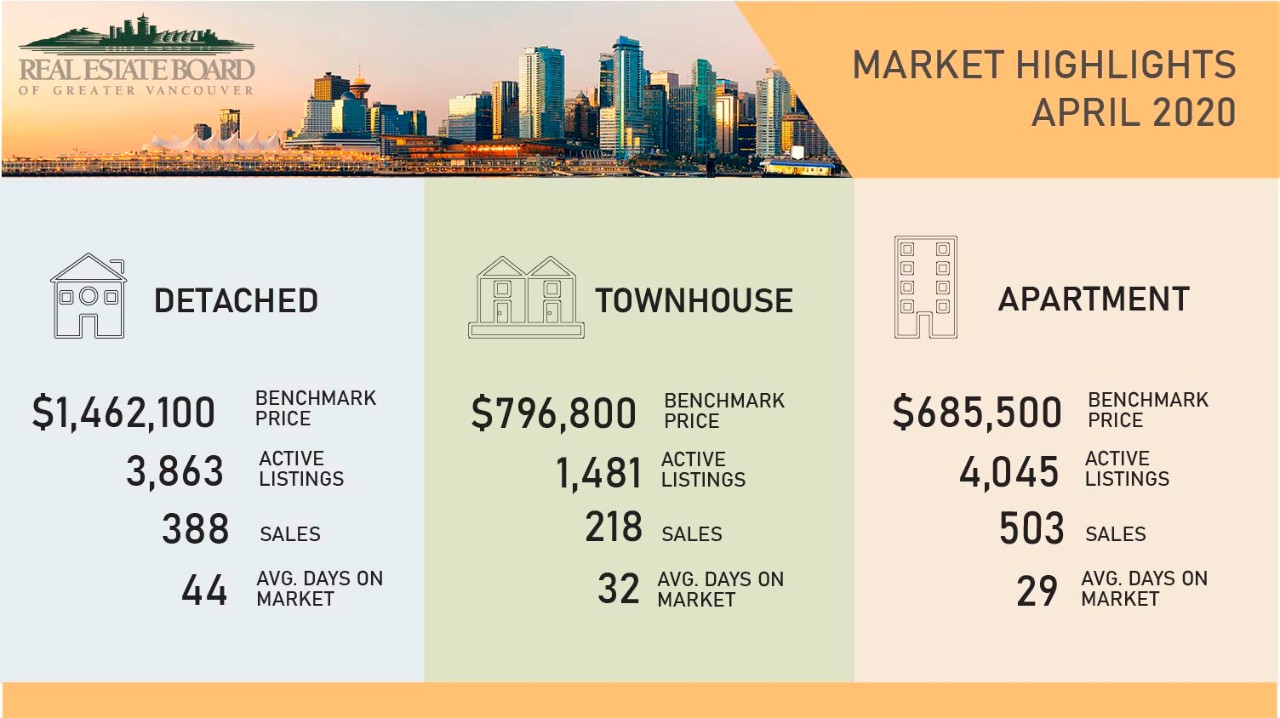
While Metro Vancouver* home sale and listing activity remains limited by the COVID-19 situation, we REALTORS® across the region are fast adopting new tools and practices to help advise and serve our clients in a responsible way.
The Real Estate Board of Greater Vancouver (REBGV) reports that residential home sales in the region totalled 1,109 in April 2020, a 39.4 per cent decrease from the 1,829 sales recorded in April 2019, and a 56.1 per cent decrease from the 2,524 homes sold in March 2020.
Last month’s sales were 62.7 per cent below the 10-year April sales average and was the lowest total for the month since 1982.
Predictably, the number of home sales and listings declined in April given the physical distancing measures in place. People are, however, adapting. They’re working with us to get information, advice and to explore their options so that they’re best positioned in the market during and after this pandemic.
Realtors have been named an essential service by the provincial government to help the home buying and selling community meet their housing needs during the pandemic.
We’re seeing more innovation in today’s market. We are using different technology to showcase homes virtually, assess neighbourhood amenities and handle paperwork electronically with our clients.
There were 2,313 detached, attached and apartment properties newly listed for sale on the Multiple Listing Service® (MLS®) in Metro Vancouver in April. This represents a 59.7 per cent decrease compared to the 5,742 homes listed in April 2019 and a 47.9 per cent decrease compared to March 2020 when 4,436 homes were listed.
The total number of homes currently listed for sale on the MLS® system in Metro Vancouver is 9,389, a 34.6 per cent decrease compared to April 2019 (14,357) and a 2.3 per cent decrease compared to March 2020 (9,606).
For all property types, the sales-to-active listings ratio for April 2020 is 11.8 per cent. By property type, the ratio is 10 per cent for detached homes, 14.7 per cent for townhomes, and 12.4 per cent for apartments.
The MLS® Home Price Index composite benchmark price for all residential properties in Metro Vancouver is currently $1,036,000. This represents a 2.5 per cent increase over April 2019 and a 0.2 per cent increase compared to March 2020.
Home prices have held relatively steady in our region since the COVID-19 situation worsened in March.
Sales of detached homes in April 2020 reached 388, a 33.8 per cent decrease from the 586 detached sales recorded in April 2019. The benchmark price for detached properties is $1,462,100. This represents a 2.3 per cent increase from April 2019 and a 0.8 per cent increase compared to March 2020.
Sales of apartment homes reached 503 in April 2020, a 43.2 per cent decrease compared to the 885 sales in April 2019. The benchmark price of an apartment property is $685,500. This represents a 2.7 per cent increase from April 2019 and a 0.2 per cent decrease compared to March 2020.
Attached home sales in April 2020 totalled 218, a 39.1 per cent decrease compared to the 358 sales in April 2019. The benchmark price of an attached home is $796,800. This represents a 2.8 per cent increase from April 2019 and a 0.6 per cent increase compared to March 2020.


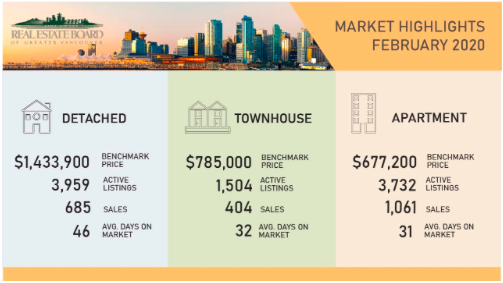
Steady demand and low supply benefits home sellers
February saw steady home buyer demand and reduced home seller supply across Metro Vancouver.
The Real Estate Board of Greater Vancouver (REBGV) reports that residential home sales in the region was 2,150 in February 2020, a 44.9 per cent increase from the 1,484 sales recorded in February 2019, and a 36.9 per cent increase from the 1,571 homes sold in January 2020.
Last month’s sales were 15.6 per cent below the 10-year February sales average.
Home buyer demand again saw strong year-over-year increases in February while the total inventory of homes for sale struggled to keep pace. This was most pronounced in the condominium market.
There were 4,002 detached, attached and apartment homes newly listed for sale on the Multiple Listing Service® (MLS®) in Metro Vancouver in February 2020. This represents a 2.8 per cent increase compared to the 3,892 homes listed in February 2019 and a 3.4 per cent increase compared to January 2020 when 3,872 homes were listed.
The total number of homes currently listed for sale on the MLS® system in Metro Vancouver is 9,195, a 20.7 per cent decrease compared to February 2019 (11,590) and a 6.7 per cent increase compared to January 2020 (8,617).
There has been increased traffic at open houses and multiple offer scenarios in certain pockets of the market.
Sales of detached homes in February 2020 reached 685, a 52.9 per cent increase from the 448 detached sales recorded in February 2019. The benchmark price for a detached home is $1,433,900. This represents a 0.7 per cent decrease from February 2019 and a 1.9 per cent increase over the past six months.
Sales of apartment homes reached 1,061 in February 2020, a 39.8 per cent increase compared to the 759 sales in February 2019. The benchmark price of an apartment property is $677,200. This represents a 0.9 per cent increase from February 2019 and a 3.6 per cent increase over the past six months.
Attached home sales in February 2020 totalled 404, a 45.8 per cent increase compared to the 277 sales in February 2019. The benchmark price of an attached home is $785,000. This represents a 0.6 per cent increase from February 2019 and a 1.7 per cent increase over the past six months.
For a more detailed view of what’s happening in your neighborhood or building, please reach out to me anytime for a complimentary update.

11 Tips for Staying Calm During the Time of the Coronavirus.
There's so much fear and uncertainty around the rapidly evolving COVID-19 situation.
How can we be as calm and happy as we can be, under these circumstances?
For people who are fortunate enough to be in good health (remember gratitude!), in addition to crucial health measures such as washing our hands and practicing social distancing, what can we do in a challenging time like this?
Keep a journal of this time. It's a milestone in the life of the world, and when this is all over,
(and at some point, it will be over), you may be very glad you kept a record.

This self-assessment tool, developed with the BC Ministry of Health, will help determine whether you may need further assessment or testing for COVID-19. You can complete this assessment for yourself, or on behalf of someone else, if they are unable to.
Click https://rem.ax/2U0o9tn to take the self-assessment.
 The data relating to real estate on this website comes in part from the MLS® Reciprocity program of either the Greater Vancouver REALTORS® (GVR), the Fraser Valley Real Estate Board (FVREB) or the Chilliwack and District Real Estate Board (CADREB). Real estate listings held by participating real estate firms are marked with the MLS® logo and detailed information about the listing includes the name of the listing agent. This representation is based in whole or part on data generated by either the GVR, the FVREB or the CADREB which assumes no responsibility for its accuracy. The materials contained on this page may not be reproduced without the express written consent of either the GVR, the FVREB or the CADREB.

